
There is a notebook sitting on a kitchen table somewhere in Jaén right now. It has a coffee stain on the cover, three months of treatment records inside, and a missing page from February that tore out when it got wet in the field. The farmer who owns it would tell you his records are "more or less in order." An inspector might disagree.
For generations, the cuaderno de campo — the field notebook — has been the backbone of Spanish farm record-keeping. A simple, physical book where farmers log their treatments, inputs, and activities. It worked well enough when regulations were simpler, inspections were rare, and nobody asked for three years of traceable data.
Those days are gone.
The regulatory landscape has changed fundamentally. EU Regulation 2023/564 mandates digital phytosanitary records from January 2026. SIEX requires structured digital data. CAP payments depend on verifiable records. Inspectors want specific product codes, parcel references, and operator certifications — and they want them immediately. A paper notebook, no matter how diligently maintained, is no longer fit for purpose.
The Five Problems With Paper
This is not about technology for technology's sake. Paper notebooks fail in five specific, practical ways that cost farmers time, money, and peace of mind.
Paper gets damaged. Farmers work in the field — under rain, in dust, with wet hands. Notebooks get soaked, stained, dropped in mud, and left in truck cabins through summer heat. Pages stick together, ink bleeds, and entries become unreadable. The record you wrote in March may be illegible by September, which is exactly when an inspector might ask to see it.
Memory fades. The cuaderno de campo is only useful if entries are made promptly. But after a long day of treatments across multiple parcels, the last thing any farmer wants to do is sit down and write. So entries get delayed — a day, three days, a week. By then, the details are fuzzy. Was it 2.5 litres per hectare or 3? Was it parcela 7 or parcela 8? Did Pedro or Juan do the application? These uncertainties become compliance risks.
Product codes are a nightmare. Every phytosanitary product has a MAPA registration number. Every treatment record must include it. Looking up the right code for the right product — especially when you use the commercial name and the official registry uses the active ingredient — is tedious work that adds minutes to every single entry. Many farmers simply skip it, creating an incomplete record.
Organisation is impossible at scale. A small farm with 5 parcels and 10 treatments per year can manage on paper. A medium farm with 20 parcels and 100+ treatments cannot. Flipping through a notebook to find all treatments for parcela 12 during the last campaign, or calculating total product usage across all parcels, requires manual compilation that takes hours.
Sharing and reporting are manual. When your gestor needs your data for the CAP application, what happens? You hand over the notebook, or you photograph pages and send them on WhatsApp. Your gestor then manually transcribes everything into the digital system. This is duplicated work — the same data entered twice, with the risk of transcription errors.
The Inspector at Your Door
Let's talk about what actually happens during an inspection, because this is where paper fails most dramatically.
A phytosanitary inspector arrives — sometimes with 48 hours' notice, sometimes unannounced. They ask to see your cuaderno de campo for the last three years. You need to produce records showing every treatment you applied, with the product used (MAPA registration number), the dose, the date, the parcela, the operator (ROPO certificate number), and the reason for the treatment.
With a paper notebook, this means pulling out multiple notebooks (one per year, if you are organised), flipping through pages, hoping nothing is missing, and hoping the inspector can read your handwriting. If a page is torn, stained, or missing — you have a gap in your records that you cannot fill.
With a digital system, you open the app on your phone and show the inspector a clean, complete, searchable record. Filter by parcela, by date, by product. Every entry has all required fields. Every product has its MAPA code. Every operator has their ROPO number linked. You can generate a PDF report and email it to the inspector on the spot.
The difference is not subtle. It is the difference between scrambling and confidence.
What Non-Compliance Actually Costs
The financial exposure from poor records runs on two tracks.
Phytosanitary fines under RD 1311/2012. Failure to maintain proper treatment records is a sanctionable offence under Spain's phytosanitary use regulation. Fines are classified as minor (€300–€3,000), serious (€3,001–€60,000), and very serious — depending on the nature and scale of the breach. A single inspection finding incomplete records typically triggers a first warning with a correction deadline; repeated or wilful non-compliance leads to the fine.
CAP payment reductions. Under EU conditionality rules, SIEX/SIGPAC mismatches and missing digital records can result in PAC payment reductions of 3% to 100% of your annual subsidy. For a farm receiving €12,000 per year, a 3% reduction is €360 — every year the problem persists. Serious or intentional failures can eliminate the payment entirely. This is the biggest financial risk for most farms, because it compounds silently until an audit surfaces it.
The total cost of non-compliance is rarely a single event. A first inspection that finds gaps typically triggers a follow-up visit — and if the second visit finds the same problems, the farm enters a higher-scrutiny tier with potential multi-year consequences.
"But I've Always Done It This Way"
This is the most common objection, and it deserves respect. Paper has worked for decades. Changing a system that works — even imperfectly — feels risky. Why fix what is not broken?
The honest answer: it is broken. You may not have felt the break yet, but the regulatory environment has shifted permanently. Digital phytosanitary records are mandatory from January 2026. The window for "more or less in order" is closed.
And here is the thing many farmers do not realise: going digital does not mean learning to use a computer. It does not mean complex software with dozens of menus. Modern farm management tools are designed specifically for people who are not comfortable with technology.
Koru, for example, lets you record by voice. You open the web app — it also opens in your phone's browser — tap one big button and speak: "Hoy eché cobre en el olivar norte, 3 hectáreas." That is the entire interaction. No typing, no menus, no product code lookup. The AI handles the rest.
If you can describe your work to a neighbour over the fence, you can use a digital cuaderno de campo.
What Digital Actually Looks Like
Forget the image of a farmer hunched over a laptop entering data into spreadsheet cells. That is not what digital farm management means in 2026.
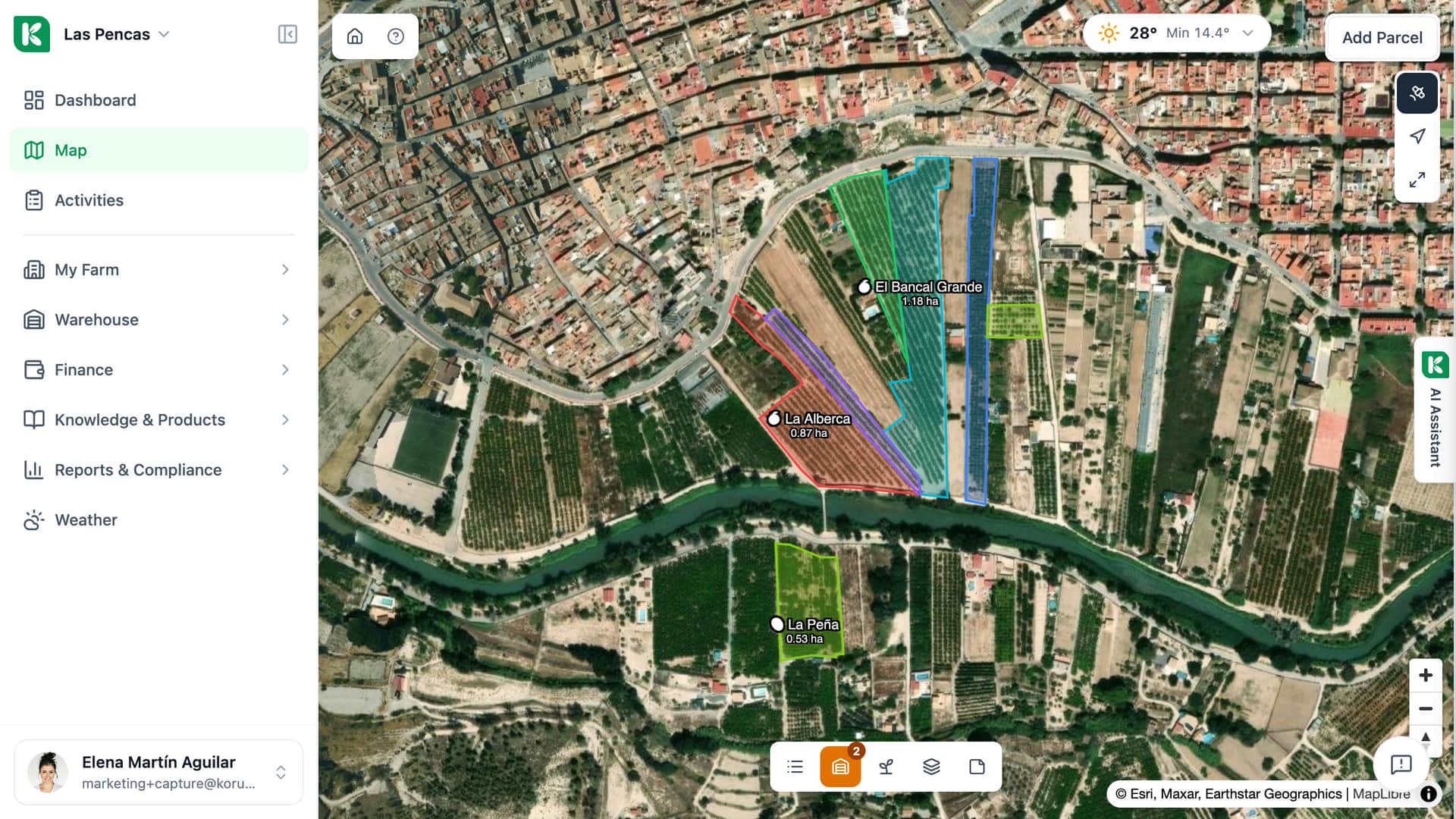
Digital means you speak into your phone while walking back to the truck after a treatment. It means your parcels are visible on a map with their real boundaries from SIGPAC. It means the product you used is automatically matched to the MAPA database — correct registration number, authorised dose, waiting period — without you looking anything up.
It means your gestor receives structured, clean data instead of photographs of handwritten pages. It means compliance reports generate with one tap. It means when your ROPO certificate is about to expire, you get a notification instead of discovering it during an inspection.
And it means that three years from now, when an inspector asks for the treatment history of parcela 14 during the 2026 campaign, you pull it up in five seconds. Not five minutes of flipping through a stained notebook. Five seconds.
The Transition Is Simpler Than You Think
Most farmers using Koru record their first treatment within five minutes of creating their account. You import your PAC document — which you already have — and your parcels appear on the map automatically. No manual data entry. No setup beyond choosing your farm name.
From that point, every treatment you record by voice is one entry you will never need to write on paper again. The transition does not happen all at once. You simply start recording your next treatment with your voice instead of a pen. And then the next one. And the next one.
Within a week, you have a digital cuaderno de campo that is more complete, more accurate, and more useful than any paper notebook you have ever kept.
The paper field notebook served Spanish agriculture well for a long time. But its time is over. What comes next is simpler, faster, and built for the way you actually work.
The Takeaway
Paper worked when the rules were loose. Today's compliance environment — mandatory digital phytosanitary records since January 2026, SIEX, CAP conditionality, ROPO, MAPA — demands structured, retrievable, three-year-deep records. Voice-first digital tools remove every reason farmers used to give for sticking with paper.
Sources & Further Reading
- BOE — Real Decreto 1311/2012, de 14 de septiembre — phytosanitary use regulation; sanction regime Articles 84–91
- BOE — Real Decreto 34/2025 — digital phytosanitary records mandatory 1 Jan 2026
- FEGA — Portal SIEX
Conclusion
Want a free, printable Paper-to-Digital Migration Checklist? One page. Six steps. Everything you need to make the switch in a single weekend.
Or skip the paperwork entirely and ask for a demo → — your cuaderno de campo digital, powered by voice.
Pro Small Farm (up to 100 ha): €49.00/month. Pro Large Farm (up to 1,000 ha): €99.00/month.